
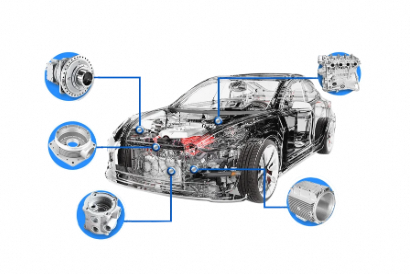
CNC MACHINING SERVICES OVERVIEW
CNC machining unlocks the full potential of aluminum die castings. While die casting produces near-net-shape parts, achieving final dimensional accuracy, intricate details, and optimal surface finish typically requires precision secondary machining. This is where CNC processes become indispensable, transforming castings into components that meet exact design specifications.
CNC TURNING
DAMAG can accommodate almost any size and type of turning application. Most work fits within a 50mm (2 inch) diameter capability. Larger diameters typically move to chuck type lathes or short-bar automatic machines.
Swiss screw machining is a specialty at DAMAG. Modern screw machines under 25mm typically use swiss type cutting and holding methods. This method was developed many years ago by Swiss machinery builders which allows the bar stock to move in/out of the cutting area using a sliding headstock. The headstock is the collet that supports the bar material. The cutting of material is done immediately at the collet support to minimize the flex of the bar material. This allows long thin parts to be cut with great precision. DAMAG uses the latest machine and tooling technology to provide cost effective screw machine parts.
CNC MILLING
CNC milling workshop handles a full range of operations including surface milling, contouring, drilling, and threading. It is ideally suited for the precision production of features like planes, grooves, bores, and continuous threads.CNC milling is a process in which the cutting tool rotates and moves into the workpiece to remove the desired material. Milling is categorized into vertical and horizontal orientations, as well as the number of axes of motion. DAMAG has a wide range of milling capabilities to suit your exact need.
3-,4-, and 5-axis capabilities
Extensive material selection of plastics and metals
Rapid Prototyping to high-volume manufacturing
BRING YOUR DIE-CAST PARTS TO LIFE WITH EASE
CNC MACHINED MAGNESIUM & ALUMINUM ALLOYS ADVANTAGES
INTEGRATED COMPLEXITY & STRUCTURAL EFFICIENCY
The synergy of die casting's net-shape forming and CNC's subtractive machining allows complex features—thin walls, deep cavities, fine threads, and undercuts—to be consolidated into a single part. This reduces assembly steps, minimizes part count, and enhances overall structural integrity.
OPTIMIZED PERFORMANCE & MATERIAL VERSATILITY
Precision machining optimizes material distribution—adding ribs for stiffness or thinning non-critical areas—to create components with an exceptional strength-to-weight ratio. Compatible with aluminum, magnesium, zinc, and specialty alloys, parts can be engineered for specific needs: high thermal conductivity, EMI/RFI shielding, or superior corrosion resistance.
SEAMLESS SCALABILITY FROM PROTOTYPE TO PRODUCTION
The process enables rapid prototyping using machined castings, followed by a seamless transition to high-volume production. Once tooling is proven, thousands of identical parts can be manufactured with minimal variation, offering both agility for R&D and the economies of scale for mass production.
SUPERIOR SURFACE & FUNCTIONAL FINISH
Post-casting machining removes parting lines, ejector marks, and surface porosity. When combined with secondary processes like anodizing or powder coating, surface finishes of Ra 0.4µm or finer are achieved, meeting the highest functional and aesthetic standards for automotive, consumer electronics, and beyond.
FROM CASTING TO PRECISION: COMPLETE MAGNESIUM & ALUMINUM SOLUTIONS
At DAMAG, we offer more than just die casting. As a integrated manufacturer, we provide complete secondary machining capabilities, including precision CNC milling, CNC turning, and EDM services, to transform raw die-cast aluminum parts into finished components that meet your exact specifications.
ELECTRICAL DISCHARGE MACHINING (EDM)
EDM also known as die sinking or wire burning is a process in which metal is removed from the workpiece by electrical discharges between two electrodes, separated by dielectric fluid. Imagine an electrically charged hair thin wire that will melt away tiny particles of metal. Wire EDM processing can hold incredibly tight tolerances, create complex and intricate shapes, work with extremely hard or soft materials, and make tiny parts. Advantages of EDM are:
Can hold incredibly tight toleran
Create complex and intricate shapes that would otherwise be impossible with conventional machining
Work with extremely hard or soft materials
Very good surface finish may be obtained
Extremely hole small holes are possible
A STRATEGIC CNC MACHINE ARSENAL
DAMAG’s manufacturing precision is powered by a diverse and advanced fleet of CNC machines, strategically selected to deliver unmatched flexibility, speed, and capability. This investment ensures we can tackle any project—from simple prototypes to the most complex, high-tolerance production runs—with optimal efficiency and quality.
3-Axis CNC: The foundation, moving a tool along the X, Y, and Z axes for fundamental milling and drilling.
4-Axis CNC: Adds a rotary axis (usually A) to the three linear axes, allowing for indexed machining on multiple sides of a part.
5-Axis CNC: The most advanced, combining three linear axes with two rotary axes (e.g., A and B). This enables continuous, simultaneous machining of intricate contours from virtually any orientation.
THE BRIDGE FROM DESIGN TO MASS PRODUCTION - HIGH-PERFORMANCE CUSTOM MOLDS
When precision and reliability are critical, custom die cast parts serve as the preferred solution across a wide range of industries. At DAMAG Die cast, we specialize in manufacturing high-quality die casting aluminum housing components and custom die cast parts, meticulously tailored to meet the unique requirements of diverse sectors;
-
Our expertise spans across demanding industries where precision and durability are non-negotiable. Explore the specific mold-making challenges we solve for each sector.
-
Our expertise spans across demanding industries where precision and durability are non-negotiable. Explore the specific mold-making challenges we solve for each sector.
-
Our expertise spans across demanding industries where precision and durability are non-negotiable. Explore the specific mold-making challenges we solve for each sector.
DAMAG is a professional die-casting manufacturer specializing in magnesium & aluminum alloy. We provide one-stop services from mold design to surface finishing. Your project, our expertise. Get in touch today.
GET MAGNESIUM & ALUMINUM DIE CASTING SERVICES AT ONE STOP!
MAGNESIUM & ALUMINUM DIE CASTING
DAMAG Diecast, a professional magnesium & aluminum die casting manufacturer based in Zhaoqing, China, offers integrated manufacturing solutions from design to delivery. Our core capabilities encompass Die Casting, Tooling Fabrication, CNC Machining, and Finishing Service, supported by rigorous Project Management, Quality Control, and efficient Supply & Logistics.
We serve a wide range of industries with dedicated product series, including: Electric vehicle sports equipment、LED display Cabinet、Car parts application.
With over a decade of experience across automotive, lighting, electronics, furniture, and construction sectors, we are committed to becoming a trusted strategic supplier to global brands.
PROJECT MANAGEMENT EXCELLENCE YOU CAN RELY ON
At DAMAG Diecast, we build more than precision parts—we build trust through systematic project management. Our process is engineered for seamless execution, ensuring your project stays on track, on budget, and fully transparent from start to finish.
Structured Governance: A clear, stage-gated process with defined milestones and deliverables.
Real-Time Visibility: Secure client portals and regular updates keep you informed—not overwhelmed.
Proactive Risk Management: We identify and mitigate risks early to prevent delays and cost overruns.
Dedicated Leadership: An assigned Project Manager serves as your single point of contact and advocate.
How We Deliver:
Your Benefit: Complete oversight without the operational burden. You retain control and clarity, while we handle the complexities of execution.
WHAT IS A CNC MACHINE USED FOR?
At the heart of modern precision manufacturing, CNC (Computer Numerical Control) machines are automated systems that produce complex parts by following programmed instructions.
Material is removed from a rotating workpiece using a stationary single-point cutting tool. Primarily produces cylindrical or conical shapes such as shafts, bolts, and bushings. Performed on lathes or turning centers.
2. CNC Turning
A versatile process where a rotating multi-point cutting tool removes material from a stationary workpiece. Capable of creating flat surfaces, slots, gears, and complex 3D contours through operations like face milling, pocket milling, and contouring.
1. CNC Milling
CNC routers are used for cutting, shaping, and engraving materials such as wood, plastic, and metal for applications in woodworking, signage, and prototyping.
3. CNC Routing
Using an abrasive rotating wheel to achieve extreme dimensional accuracy and superior surface finishes. Processes include surface grinding (flat surfaces), cylindrical grinding (external diameters), and centerless grinding (high-volume production of small cylindrical parts).
4. CNC Grinding
Creating round holes in a workpiece using rotating drill bits. Includes standard drilling, reaming (finishing existing holes), and tapping (creating internal threads). Often combined with milling in machining centers.
5. CNC Drilling
A thermal process using a focused, high-power laser beam to melt, burn, or vaporize material. Highly precise for cutting complex 2D shapes in sheet metal, plastics, and composites with minimal heat-affected zones.
6. CNC Laser Cutting
CNC plasma cutting machines use a plasma torch to cut through electrically conductive materials like steel, aluminum, and copper for applications in fabrication, construction, and metalworking.
7. CNC Plasma Cutting
CNC waterjet cutting machines use a high-pressure jet of water mixed with abrasive materials to cut through a wide range of materials including metal, glass, and stone.
8. CNC Waterjet Cutting
Enlarging and refining pre-existing holes to achieve precise diameters, superior roundness, and fine surface finishes. Essential for achieving high-precision bore tolerances in engine cylinders and bearing housings.
9. CNC Boring
A non-contact process that removes material through controlled electrical sparks (discharges) between an electrode and the conductive workpiece. Ideal for hardened steels and intricate shapes. Includes wire EDM (using a thin wire electrode) and sinker EDM (using a shaped electrode).
10. Electrical Discharge Machining (EDM)
CAD Model Creation: A part is designed in 3D using Computer-Aided Design (CAD) software (e.g., SolidWorks, AutoCAD).
CAM Programming: The CAD file is imported into Computer-Aided Manufacturing (CAM) software, where toolpaths are generated.
The CAM software defines:
Cutting tools to use Spindle speeds and feed rates
Depth of cut and movement patterns G-Code
Generation:
The CAM software converts the toolpaths into G-code—a universal machine language (e.g., G01 X10 Y20 F100) that tells the machine exactly how and where to move.
Workholding: The raw material (metal, plastic, etc.) is securely clamped to the machine bed using vises, fixtures, or chucks. Tool Loading: Required cutting tools (end mills, drills, etc.) are loaded into the machine’s automatic tool changer or spindle. Zero Point Calibration: The machine’s reference point (“work zero”) is set to align the tool with the material’s starting position.
G-code Interpretation: The CNC controller reads the G-code instructions line by line. Coordinated Motion: The controller drives servo motors along multiple axes (X, Y, Z, and sometimes A, B, C for rotation) to move the tool and/or workpiece with micron-level precision.
Material Removal: The rotating cutting tool engages with the material, removing layers through milling, drilling, turning, or grinding—shaping the part according to the programmed geometry.
Automatic Operations: Coolant/lubricant is applied to manage heat; tools may be changed automatically for different operations.
Real-Time Feedback: Sensors monitor tool wear, temperature, and vibration. Advanced systems can adjust parameters dynamically. Operator Oversight: While largely autonomous, an operator monitors the process for anomalies and ensures quality.
Part Unloading: Once machining is complete, the finished part is removed. Post-Processing: Additional steps like deburring, cleaning, or surface treatment may follow. Quality Verification: The part is inspected using tools like CMMs, calipers, or optical scanners to ensure it matches design specifications.
Six major advantages of CNC machine tools over conventional machine tools:
DAMAG Diecast’s precision CNC machining services offer high-quality, accurate, and efficient manufacturing solutions for a wide range of industries.