


DAMAG YOUR TRUSTED MAGNESIUM & ALUMINUM DIE CASTING MANUFACTURER
From Concept to Production-Ready Tooling, We Deliver High-Precision, Long-Life, Reliable Molds.

PROJECT MANAGEMENT EXCELLENCE YOU CAN RELY ON
At DAMAG Diecast, we build more than precision parts—we build trust through systematic project management. Our process is engineered for seamless execution, ensuring your project stays on track, on budget, and fully transparent from start to finish.
 Structured Governance: A clear, stage-gated process with defined milestones and deliverables.
Real-Time Visibility: Secure client portals and regular updates keep you informed—not overwhelmed.
Proactive Risk Management: We identify and mitigate risks early to prevent delays and cost overruns.
Dedicated Leadership: An assigned Project Manager serves as your single point of contact and advocate.
How We Deliver:
Your Benefit: Complete oversight without the operational burden. You retain control and clarity, while we handle the complexities of execution.
1: PROJECT INITIATION & FEASIBILITY REVIEW
We begin with a deep collaborative analysis of your part design, material selection, and performance requirements. Our team conducts a formal Design for Manufacturability (DFM) assessment, identifying potential challenges and optimizing the design for cost, quality, and cycle time before any tooling commitment.
2: CONCEPT DESIGN & FLOW SIMULATION
Our engineers develop the initial mold architecture, determining parting lines, gate locations, and ejection strategy. We then perform advanced mold flow simulation (CAE) to virtually analyze fill patterns, temperature gradients, and potential defects. This digital prototyping phase validates and optimizes the design for optimal performance.
MOLD DESIGN PROCESS AT DAMAG DIECAST
The 8-Stage Mold Design & Delivery Process: Engineered for Certainty
3: DETAILED ENGINEERING & DESIGN FREEZE
Every component is modeled in full 3D detail. We finalize all critical systems: cooling channel layout, venting design, slider & lifter mechanisms, and the ejector system. A comprehensive Tooling Design FMEA (Failure Mode and Effects Analysis) is conducted. The finalized design package is submitted for your formal approval.
4: PRECISION MANUFACTURING & IN-PROCESS QC
With your signed approval, manufacturing commences. Master toolmakers utilize high-speed CNC machining, precision EDM, and deep-hole drilling to fabricate each mold component from premium steel. In-process inspections via CMM and hardness testing ensure every piece meets exacting specifications before assembly.
5: MOLD ASSEMBLY & MECHANICAL VALIDATION
All components are meticulously assembled by senior mold technicians. The complete tool undergoes dry-cycle testing and mechanical function checks to verify smooth operation of all movements—clamping, ejection, and actuation of side-cores—ensuring flawless mechanical performance.
6: SAMPLE TRIALS (T1) & PROCESS OPTIMIZATION
The mold is installed in a die casting machine for the first-shot trial (T1). We produce initial samples while meticulously documenting and optimizing key process parameters (injection speed, pressure, temperature). The goal is to establish a stable, repeatable process window.
7: SAMPLE VALIDATION & DESIGN VERIFICATION
Trial samples undergo rigorous analysis. We perform comprehensive First Article Inspection (FAI), dimensional CMM reporting, and X-ray inspection for porosity. Data is compared against your CAD model and specifications. Any required minor adjustments are implemented in this phase.
8: FINAL APPROVAL, DOCUMENTATION & DELIVERY
Upon your approval of the validated samples, the project concludes. We deliver a complete mold data package, including final inspection reports, maintenance manuals, and process setup sheets. The mold is then prepared for secure shipment or released for scheduled production at your designated facility.
HOT CHAMBER DIE CASTING VS. COLD CHAMBER DIE CASTING
WHAT IS DIE CASTING?
For the die casting process, your metal material is melted and then transferring into a mold or a steel die. These molds or steel die allow us to mold the metal into the shape of the part you need for your project. Once the mold is filled it has a brief cooling off period to allow the metal to harden.
Magnesium
Aluminum
视频播放失败,请稍后重试
Types of metal materials we use:
Take a deeper dive into the mechanisms of die casting below.
DIE CASTING MOLD DESIGN
We start by partnering with you to refine the part design for manufacturability, performance, and cost-efficiency, using DFM and flow simulation to prevent issues before tooling. The mold is typically composed of two or more halves, facilitating the filling and removal process during casting.
Step 1
MELTING & PREPARATION
High-grade metal (magnesiu & aluminum) alloys are melted in controlled furnaces. The molten metal is then degassed and refined to remove impurities, ensuring material purity and strength.
Step 2
HIGH-PRESSURE INJECTION
The prepared metal alloys are injected into the mold cavity under intense pressure (800-1200 bar). This forces the metal to fill intricate details rapidly, capturing complex geometries with precision.
Step 3
RAPID, UNIFORM COOLING
Our temperature-controlled molds manage heat extraction to minimize internal stresses and shrinkage, yielding parts with excellent mechanical properties and dimensional stability.
Step 4
EJECTION & TRIMMING
Once solid, the mold opens, and the new casting is ejected automatically. The part is then trimmed to remove excess material (sprues and runners) and prepared for finishing.
Step 5
FINISHING & QUALITY ASSURANCE
The casting undergoes secondary processes like CNC machining, deburring, and surface treatments (e.g., powder coating, anodizing). Each part is rigorously inspected for dimensional accuracy, structural integrity, and cosmetic finish before delivery.
Step 6
DIE-CAST MAGNESIUM ALLOYS
DAMAG has extensive magnesium die casting knowledge and expertise, partnering with customers on the distinctive benefits of magnesium die casting to suit their needs. Magnesium offers a perfect combination of light weight, rigidity and resistance to wear for diverse die cast part applications.
ROBUST & VERSATILE DIE-CAST MAGNESIUM & ALUMINUM SOLUTIONS
DAMAG has provided innovative casting solutions since 2008. We are one of the few fully integrated, single-source magnesium & aluminum die casters that offer expertise from design through finishing, assembly, and logistics. In addition, we offer a variety of aluminum & magnesium alloy parts die costing options for almost any use case.

DIE-CAST ALUMINUM ALLOYS
DAMAG has extensive magnesium die casting knowledge and expertise, partnering with customers on the distinctive benefits of magnesium die casting to suit their needs. Magnesium offers a perfect combination of light weight, rigidity and resistance to wear for diverse die cast part applications.
Whether it is to prototype new designs, assist you in selecting the best alloy for the application, technical feasibility consultancy or design for manufacturing to optimize the design regarding lightweight, performance and cost, our Product Engineering Team is prepared to support you at the early stages of ideation and concept as well as during serial production. Our expertise in die casting allows us to provide high-quality, precision aluminum and magnesium die casting parts that meet the specific requirements for your project.
TYPES OF DIE CASTING METAL WE SUPPLY
MAGNESIUM DIE CASTING SERVICES
AZ91D: AZ91D is the most commonly used magnesium die cast alloy that has an outstanding combination of mechanical properties, castability, and corrosion resistance.
AZ91HP: This alloy has been specifically developed for corrosive environments, and has lower levels of nickel, iron, copper and silicon than AZ91D.
AM60B: This magnesium alloy has excellent energy absorption characteristics along with excellent ductility. AM50B also has slightly higher strength that AM50A, but with otherwise similar properties

ALUMINUM DIE CASTING SERVICES
A360: Best corrosion resistance. Can be more expensive depending on application.
A369: Excellent die filling properties and good wear, high elongation value relative to other aluminum alloys.
A365 (Silafont-36): Very good corrosion resistance, excellent weldability, and high fatigue strength.
A380 & E380: An alloy with the best cost/utility ratio.
A383, B383, & A384: All modifications of 380. Each provide better die filling, but with a reasonable sacrifice in mechanical properties, like toughness.
B390: Used for specific applications where strength, wear-resistance/bearing properties and fluidity are a necessity.
A413: Used for maximum pressure tightness and fluidity.
MAGSIMAL-59: Excellent mechanical properties, very good weldability and corrosion resistance, good machinability.
THE BRIDGE FROM DESIGN TO MASS PRODUCTION - HIGH-PERFORMANCE CUSTOM MOLDSYOUR VISION, OUR CRAFT: SEAMLESS MOLD DEVELOPMENT
When precision and reliability are critical, custom die cast parts serve as the preferred solution across a wide range of industries. At DAMAG Die cast, we specialize in manufacturing high-quality die casting aluminum housing components and custom die cast parts, meticulously tailored to meet the unique requirements of diverse sectors:
-
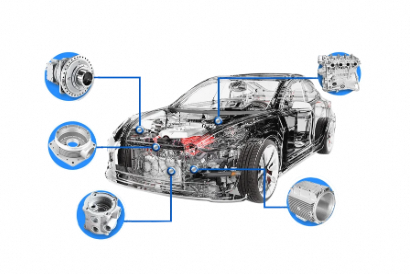
Our expertise spans across demanding industries where precision and durability are non-negotiable. Explore the specific mold-making challenges we solve for each sector.
-
Our expertise spans across demanding industries where precision and durability are non-negotiable. Explore the specific mold-making challenges we solve for each sector.
-
Our expertise spans across demanding industries where precision and durability are non-negotiable. Explore the specific mold-making challenges we solve for each sector.
COLD CHAMBER HIGH PRESSURE DIE CASTING CAPABILITY
There are two primary methods for die casting: hot chamber die casting and cold chamber die casting. For aluminum alloy die casting, we primarily employ cold chamber pressure die casting machines, while the hot chamber method is often used for alloys like zinc due to their lower melting points.
At Bian Diecast, our factory is fully equipped with a variety of die casting machines. Each machine is capable of producing at least 2000 to 3000 die casting components per day. The largest casting area reach 3125cm².
A brief list of our high pressure die casting machines catering to different sizes of parts:
| 1250T Die Casting Machine | 1250T Die Casting Machine | 1250T Die Casting Machine |
| 1250T Die Casting Machine | 1250T Die Casting Machine | 1250T Die Casting Machine |
DAMAG is a professional die-casting manufacturer specializing in magnesium & aluminum alloy. We provide one-stop services from mold design to surface finishing. Your project, our expertise. Get in touch today.
GET MAGNESIUM & ALUMINUM DIE CASTING SERVICES AT ONE STOP!


MAGNESIUM & ALUMINUM DIE CASTING
DAMAG Diecast, a professional magnesium & aluminum die casting manufacturer based in Zhaoqing, China, offers integrated manufacturing solutions from design to delivery. Our core capabilities encompass Die Casting, Tooling Fabrication, CNC Machining, and Finishing Service, supported by rigorous Project Management, Quality Control, and efficient Supply & Logistics.
We serve a wide range of industries with dedicated product series, including: Electric vehicle sports equipment、LED display Cabinet、Car parts application.
With over a decade of experience across automotive, lighting, electronics, furniture, and construction sectors, we are committed to becoming a trusted strategic supplier to global brands.

WHY IS THE MOLD SO CRITICAL?
Determines Part Quality: The mold's precision directly defines the part's dimensional accuracy, surface finish, and structural integrity.
Impacts Production Efficiency: A well-designed mold with efficient cooling allows for faster cycle times and higher productivity
Affects Long-Term Cost: While the initial mold is a significant investment, a durable, well-made mold can last for hundreds of thousands of cycles, making it cost-effective for high-volume production.
Enables Complexity: It allows for the production of intricate shapes, thin walls, and integrated features (like bosses and ribs) that would be difficult or impossible with other manufacturing methods.
| Aspect | Hot Chamber Die Casting | Cold Chamber Die Casting |
| Typical Alloys | Lower Melting Point Metals: • Zinc (Zn) • Magnesium (Mg) • Lead (Pb) • Tin (Sn) |
Higher Melting Point Metals: • Aluminum (Al) • Copper (Cu)/Brass • Some Magnesium (Mg) alloys |
|
Process Schematic |
The gooseneck (injection cylinder) is permanently immersed in a pool of molten metal housed within the machine | The injection chamber (shot sleeve) is separate from the melting furnace. Molten metal is ladled manually or automatically into the cold chamber |
| Cycle Speed | Very Fast (can be <1 second for small parts). No metal transfer step | Slower, Ladling step adds time. Higher pressures may require longer intensification |
| Advantages | • Faster cycles, higher production rates • Better process stability & consistency • Reduced metal oxidation & contamination • Longer gooseneck life |
• Can cast high-melting-point alloys (Al, Cu) • Produces higher-integrity, denser parts • Handles larger part sizes • More versatile for alloy choice |
| Disadvantages | • Limited to lower melting point alloys • Generally smaller part sizes |
• Slower cycle times • Higher risk of porosity if not optimized • Higher wear on shot sleeve and plunger |
Our engineering team is here to guide you. We analyze your part design, performance requirements, and production volume to recommend the optimal process—ensuring you get the right balance of quality, performance, and cost.
Not sure which process fits your project?
Contact us to discuss your next die casting project.

Scan The Code
